
Overview:
India remains the leader of the global pharmaceutical industry owing to sophisticated liquid injection manufacturing infrastructure and dedicated contract facilities. At the moment, the domestic market of India for ampoules, powder vials, and prefilled syringes is larger than 25,000 crore Indian rupees. In addition, hospitals located in the country require high-quality parenterals for use daily for providing patients with critical care. Therefore, outsourcing drug production to certified contract units will assist pharmaceutical brand owners to develop significantly without making an investment higher than 50 lakh Indian rupees in establishing their own facilities. Also, starting a custom commercial batch requires a modest budget, which starts from 50,000 Indian rupees and goes till 1.5 lakh Indian rupees.
Thus, knowing the principles of sterile processes, regulatory requirements, and WHO-GMP quality standards will ensure successful commercial development in the future. This guide covers the most important aspects of working with the top injectable manufacturers company in India.
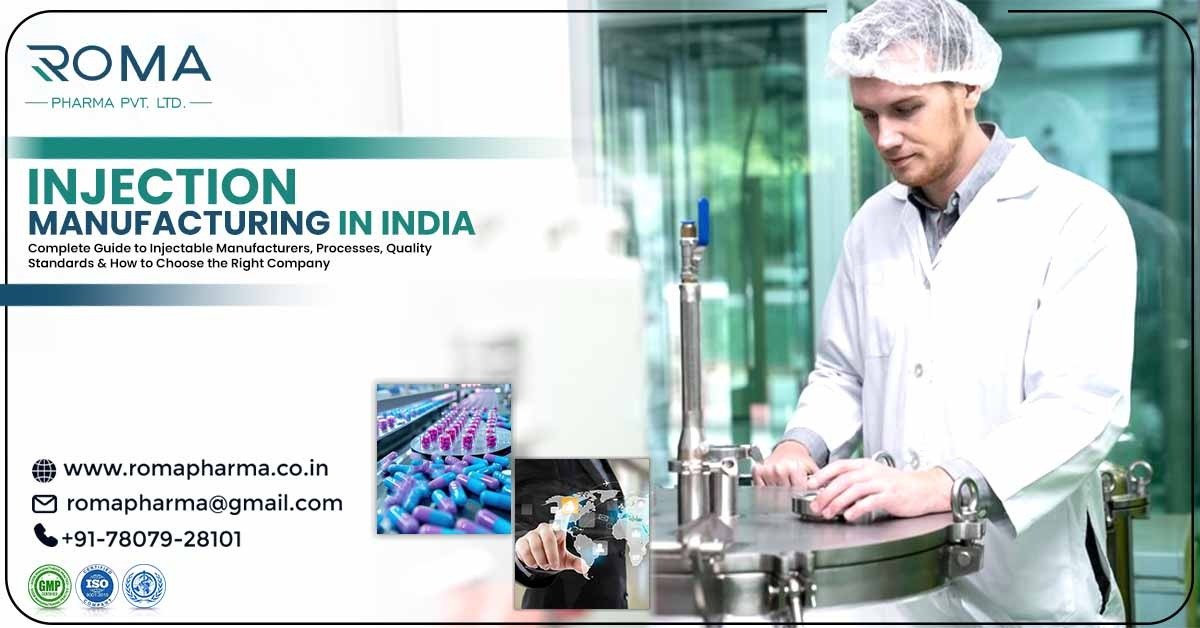
What Is Injection Manufacturing in India, and How Is the Process Performed?
Basically, the process of sterile pharmaceutical production involves special environmental control systems in certified cleanrooms. Accordingly, modern injectable manufacturers of liquid injections systematically perform mixing of active pharmaceutical ingredients and sterile liquids to obtain liquid injectable drug dosage form.
- Firstly, raw active compounds are thoroughly inspected in certified quality labs.
- Secondly, automatic tanks perform the dissolution of active compounds in a sterile way.
- Thirdly, specialized membrane filters ensure sterilization of the obtained solution prior to filling.
- Fourthly, automatic machines perform the filling of sterile glass vials or ampoules in cleanroom settings.
- Fifthly, sterile containers go through terminal sterilization and a rigorous leakage testing procedure.
Additionally, production of a commercial third-party batch usually demands an investment of 50,000 to 1.5 lakh Indian rupees. Thus, a properly structured injection manufacturing workflow ensures complete protection against any kind of microbial contamination and extends the life of the products.
What Quality Standards Do Injectable Manufacturers in India Follow?
Nowadays, sterile liquid injection manufacturing facilities should be compliant with national and international regulations in order to provide complete safety of products.
| Regulatory Requirement | Regulatory Authority / Standard Body | Purpose of Regulation |
|---|---|---|
| WHO-GMP Certification | World Health Organization / Applicable Regulatory Authorities | Supports good manufacturing practices, hygiene, contamination control, and consistent pharmaceutical production. |
| ISO 9001:2015 | International Organization for Standardization | Provides a structured quality management system focused on process consistency, documentation, and continual improvement. |
| Schedule M Standards | CDSCO / Ministry of Health & Family Welfare, India | Specifies requirements for pharmaceutical manufacturing premises, equipment, hygiene, quality control, and related manufacturing practices. |
| GLP Principles | Applicable National and International Regulatory Bodies | Supports reliable laboratory practices, proper documentation, data integrity, and quality of non-clinical testing. |
What Points Should You Take Into Account While Choosing a Good Injection Manufacturer in India?
Confirmation of Necessary Regulatory Certification:
Firstly, you should check if your chosen injection manufacturing company in India complies with the required WHO-GMP and ISO standards. Accordingly, this guarantees proper filtration of the cleanroom’s air by HEPA filters and the absence of any kind of microbiological pollution.
Determination of Capacity of Production:
Also, one should estimate the equipment capacity during the selection of a manufacturer of injectable drugs in India. In this way, high-speed automatic filling machines guarantee prompt performance of big hospital orders without delay.
Estimation of Initial Batch Costing:
Also, the cost of each batch of the products should be considered while choosing an injection manufacturing company in India. Thus, flexibility of the initial order cost (starting from 50,000 rupees) will help pharmaceutical companies to expand safely.
Quality of Vials Packaging:
Moreover, one should be sure that the injectable manufacturers company in India that he or she works with uses Type-I borosilicate vials for storage. In this way, a moisture-resistant type of packaging guarantees a stable chemical composition during 36 months storage period.
Quality Control Facilities in the Company:
Finally, one should determine if there are GLP-certified laboratories at the chosen manufacturing facility. In this way, the sterility test, test for particle size, and endotoxin assay guarantee compliance with all the regulations prior to the dispatch of the batches.
How Do Injectable Manufacturers in India Ensure High Quality, Safety, and Compliance of Drugs?
Definitely, the top injectable manufacturers implement strict quality control practices during all stages of the process. Hence, cleanrooms maintain positive air pressure in order to exclude the possible presence of microorganisms during processing.
- HEPA air filtration systems ensure the purification of the environment of the processing room.
- Optical cameras monitor the state of the filling machine and perform scanning of every vial for the presence of glass particles instantly.
- Laboratory specialists perform LAL endotoxin tests on the completed batches.
- Environmental monitoring units perform measuring of pressure and humidity levels constantly.
- Quality assurance specialists conduct a review of every batch prior to its release.
Thus, maintaining high standards will protect the health of the patients and the commercial interests of pharmaceutical brands. Additionally, spending 1.5 lakh Indian rupees on certified injection manufacturing guarantees high quality of batches and successful business expansion.
The Bottom Line:
In conclusion, cooperation with good partners in the field of injection manufacturing provides unique business expansion opportunities for modern pharma companies. Also, outsourcing the production of vials and dry powders excludes the necessity to build costly facilities, which require more than 50 lakh Indian rupees. In this way, selection of the proper partners guarantees high margins, quick approvals, and safe batches.
Particularly, direct collaboration with Roma Pharma will guarantee the provision of quality WHO-GMP injection manufacturing services. Thus, start cooperating with Roma Pharma right now and establish a dominant market position securely!
Frequently Asked Questions:
Q1: What is the meaning of sterile injection manufacturing?
A1: This is sterile manufacturing of liquid ampoules, vials, and powder inside a HEPA-filtered cleanroom environment.
Q2: What initial capital is needed for contract manufacturing?
A2: Generally, launching third-party batch of products requires an initial investment between 50,000 and 1.5 lakh Indian rupees.
Q3: How do cleanrooms provide sterile environment?
A3: They have HEPA filters and a system of positive air pressure difference that excludes any contamination of the environment with microorganisms.
Q4: What documents are necessary for the launch of third-party manufacturing?
A4: One needs to present the Drug License, GST registration, incorporation certificate of the company, and trademark registration document.
Q5: Why is LAL endotoxin testing performed?
A5: This test guarantees the absence of pyrogens in the batch.
Q6: What is the lead time for repetition of the order?
A6: Repeat batches are processed, tested, packed & dispatched within 15 business days.
Q8: How do automated visual inspection systems work?
A8: Optical cameras inspect each vial for the existence of particles, seals defects, and errors of filling.
Q9: How is an accelerated stability test performed?
A9: Vials are kept in stability chambers at a temperature 40°С and 75% humidity for six months.
Q10: How does contract manufacturing help to decrease risk capital?
A10: This allows pharmaceutical brands to launch new products without investment exceeding 50 lakh rupees.